
Documentation Index
Fetch the complete documentation index at: https://docs.qu.ai/llms.txt
Use this file to discover all available pages before exploring further.
What is Finality?
When you send a transaction, how long do you have to wait before you’re confident it can’t be reversed? This waiting time is called finality. Two Types of Finality:- Statistical Finality: Mathematical certainty your transaction is permanent (barring a 51% attack)
- Economic Finality: The cost to reverse your transaction exceeds any attacker’s benefit
- Better user experience: No waiting 10+ minutes for Bitcoin confirmations
- Enables commerce: Merchants can accept payments instantly
- Reduces uncertainty: Clear when transactions are truly final
The Challenge: Quai’s Multi-Chain Architecture
Quai Network uses a hierarchy of blockchains:- Prime chains: Main coordination chains (slower, more secure)
- Region chains: Regional coordination chains
- Zone chains: Individual transaction chains (faster, where users interact)
The Withholding Attack Problem
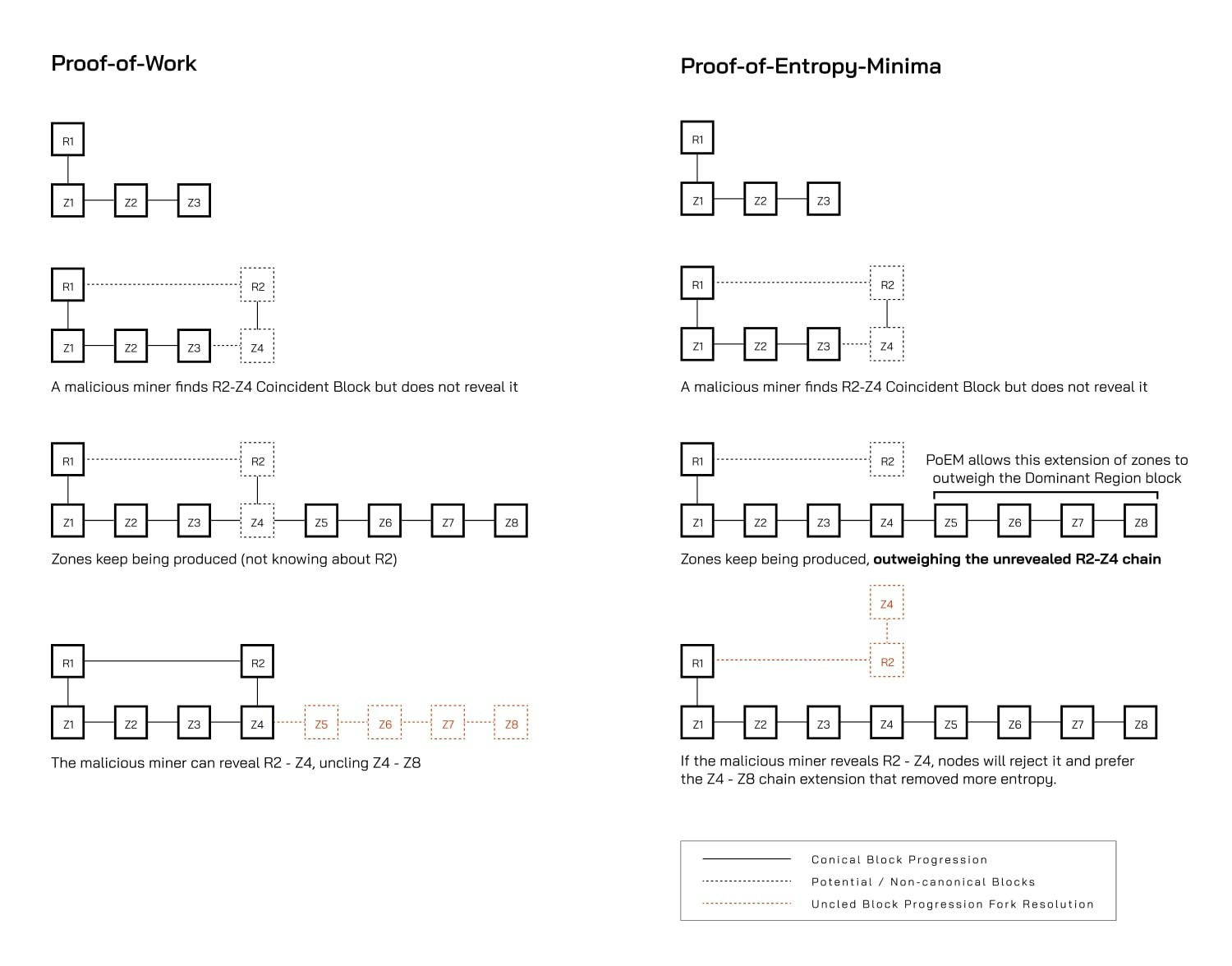
What’s a Withholding Attack? Imagine a miner finds a valid block but doesn’t immediately broadcast it. Instead, they hold it back while other miners waste energy mining the previous block. In Single Chains (like Bitcoin):- Attacker holds back a block for ~10 minutes
- Minimal impact since no transactions process between blocks
- Eventually another miner finds a block, making the withheld block worthless
- Zone chains process transactions continuously
- But those transactions aren’t final until prime chain confirms
- Attacker could hold back a prime block, keeping zone transactions uncertain
- Much more disruptive than single-chain attacks
PoEM’s Solution: Bottom-Up Finality
Traditional Hierarchy (Top-Down):- Prime chains lead, zone chains follow
- Zone transactions wait for prime confirmation
- Vulnerable to prime chain withholding attacks
- Zone chains can achieve finality independently
- Prime chains follow zone chain entropy accumulation
- Withholding attacks become ineffective
- Zone chains remove entropy faster than prime chains (due to higher frequency)
- Even the “luckiest” possible prime block can’t outweigh zone chain accumulation for long
- Transactions achieve finality in seconds, not minutes
Finality Comparison
| System | Statistical Finality Time | Method |
|---|---|---|
| Bitcoin | 10+ minutes (1 block) | Wait for longest chain |
| Ethereum | 12+ minutes (2 epochs) | Wait for 2/3 validator approval |
| Quai PoEM | ~5 seconds (1 zone block) | Entropy accumulation measurement |
- Objective measurement: Entropy is mathematically scarce, not subjective
- Independent chains: Zone finality doesn’t depend on prime blocks
- Precise calculation: Measures exact work, not arbitrary thresholds
Economic Finality: Real-World Security
What is Economic Finality? The point where reversing your transaction would cost an attacker more than they could possibly gain. Real-World Examples:- Coffee purchase ($5): Economically final almost instantly
- Car purchase ($50,000): May need 30+ minutes for full economic security
- House purchase ($500,000): Could require hours of confirmations
- Transaction value: Higher value = longer wait time needed
- Network hashrate: More miners = better security = faster finality
- Pending transactions: Network congestion affects attack costs
- Market conditions: Token price volatility impacts attack economics
Built-in Economic Finality Tool
Quai Network includes a smart finality calculator that: Analyzes Network Conditions:- Current hashrate and mining distribution
- Pending transaction volumes and fees
- Historical attack costs and patterns
- Instant decisions for small transactions
- Precise wait times for large transfers
- Real-time updates as conditions change
- Merchants: Know exactly when payments are safe
- Exchanges: Minimize deposit wait times while maintaining security
- Users: Understand the security level of their transactions
Economic finality is dynamic - the same transaction might need different wait times depending on current network conditions and market factors.