
Two Tokens, One Complete Monetary System
Most blockchains force a single token to do conflicting jobs: store of value, medium of exchange, and unit of account. Bitcoin excels as digital gold but is too volatile for everyday pricing; fiat-backed stablecoins work for payments but inherit fiat inflation and centralized custodial risk. Quai Network solves this by purpose-designing two complementary native tokens anchored by Proof-of-Work and physical energy:QUAI — Programmable Hard Money
EVM-compatible store-of-value asset with logarithmic mining issuance, ~93% circulating supply post-Polaris, and continuous SOAP buyback-and-burn.
Qi — The Energy Dollar (Flatcoin)
World’s first decentralized energy-backed flatcoin—UTXO-based digital cash whose issuance scales directly with mining energy cost.
- Store of Value (QUAI): Scarce, supply-constrained reserve asset engineered to compound value over time.
- Medium of Exchange (Qi): Cash-like UTXO currency with fixed denominations, native privacy properties, and energy-anchored stability.
- Unit of Account (Flatcoin Design): Pricing anchored to real-world energy—the fundamental input to both human commerce and AI computation.
Post-Polaris Hard-Money Fundamentals
Following the Singularity Fork (March 2026) and Polaris Fork (October 2026), Quai permanently burned ~1.90 billion of its original 3 billion genesis tokens—eliminating long-term insider overhang:- ~92.8% of QUAI supply is already circulating (
1.17B QUAI) - < 4% / year genesis inflation (down from 13%) and ~4.72% / year estimated net mining inflation after SOAP burns
- < 9% / year total inflation including SOAP burns (down from 18%)
- ~3.7M QUAI / month remaining unlocks (~90.4M locked genesis through early 2029)
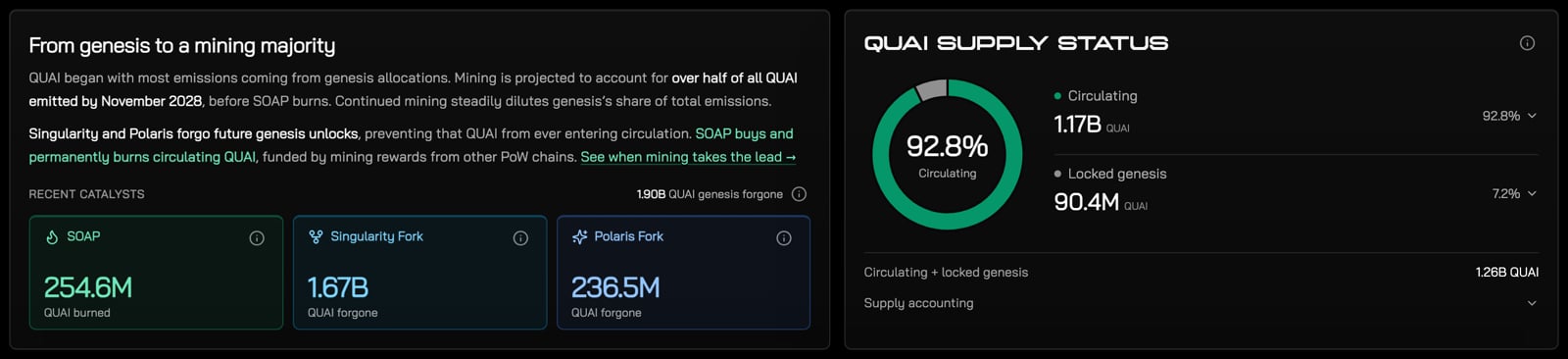
Post-Polaris QUAI supply status from supply.qu.ai
Token Names & Etymology
The token names reflect each asset’s monetary role:- Quai (pronounced “k-why”): Derives from the Chinese character 块, a colloquial term for money akin to “buck” or “quid” in English.
- Qi (pronounced “chee”): Comes from the Chinese character 气, meaning “energy” or “life force”—reflecting Qi’s design as an energy-backed flatcoin whose value is tied to physical energy production.
SOAP: Turning External Hashrate into Permanent Scarcity
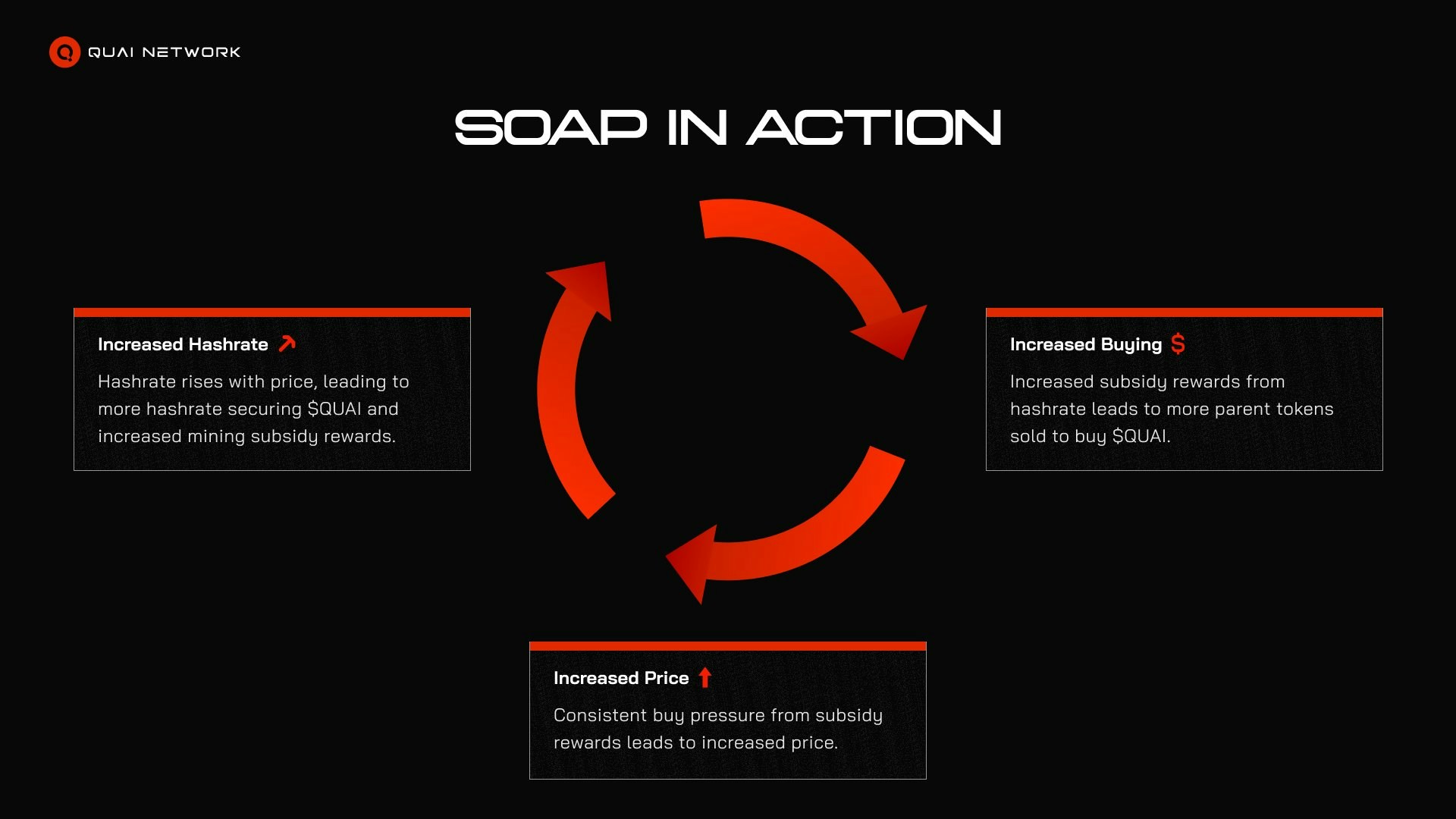
Project SOAP (Subsidized Open-market Acquisition Protocol) turns multi-algorithm merge-mining into continuous QUAI buyback and burn:- SHA-256 (BCH), Scrypt (LTC/DOGE), and KawPoW (RVN) miners submit AuxPoW workshares to Quai, routing 100% of parent-chain coinbase subsidies to protocol-controlled addresses.
- SOAP converts those external subsidies into QUAI on the open market.
- 100% of purchased QUAI is permanently burned at
0x0050AF0000000000000000000000000000000000.
Explore Tokenomics & Live Dashboards
QUAI Emissions
Post-Polaris supply equation, emission curve, and SOAP burn mechanics.
What Are Flatcoins?
Why fiat stablecoins erode purchasing power and how Qi works as an energy flatcoin.
Protocol Upgrades
Full breakdown of SOAP, Singularity (v0.51.0), and Polaris (v0.57.0).
Live Dashboards
Inspect real-time metrics at supply.qu.ai and soap.qu.ai.