> ## Documentation Index
> Fetch the complete documentation index at: https://docs.qu.ai/llms.txt
> Use this file to discover all available pages before exploring further.
# Dynamic Sharding
> The process of dynamically scaling to more shards in Quai Network.
## Automatic Network Expansion
Imagine a highway system that automatically builds new lanes when traffic gets heavy. That's essentially what Quai Network does with dynamic sharding - it automatically adds processing capacity when demand increases.
**What is Dynamic Sharding?**
The protocol automatically creates new execution shards (processing channels) when the network becomes congested, expanding capacity without human intervention or network upgrades.
**How It Works:**
1. **Network monitors demand**: Protocol tracks congestion indicators in real-time
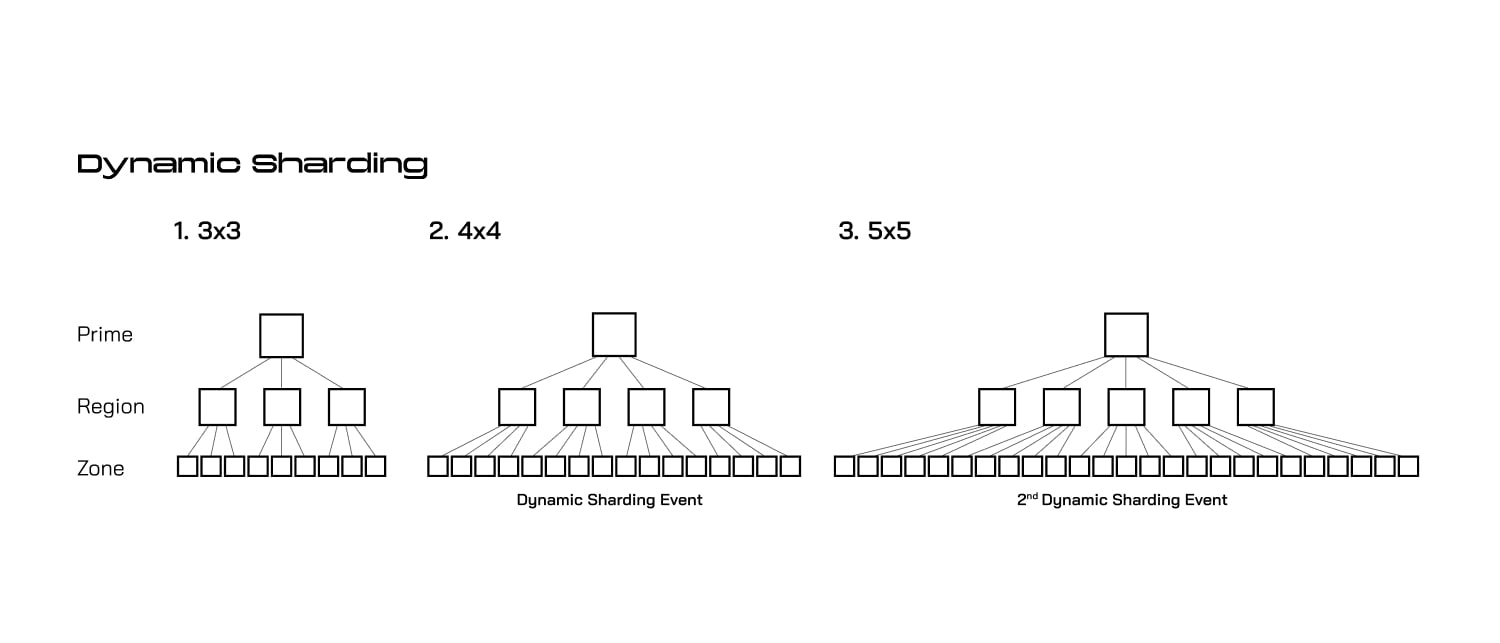
2. **Automatic expansion**: When thresholds are met, new region and zone chains are created
3. **Seamless integration**: New chains immediately join the existing consensus system
4. **Balanced growth**: All regions gain additional zones to maintain network harmony
**The Key Advantage:**
Unlike other blockchain networks that require hard forks or compromise security when scaling, Quai adds capacity automatically while maintaining full decentralization and security.
 ## How the Network Knows When to Expand
The protocol monitors two key congestion indicators to determine when new capacity is needed:
### 1. Uncle Block Rate
**What are Uncle Blocks?**
Think of uncle blocks as "traffic jams" in mining. When multiple miners find valid blocks simultaneously, only one becomes part of the main chain - the others become "uncles."
**Why This Matters:**
* **High uncle rate** = Network congestion (too many miners competing for limited space)
* **Reduced efficiency** = Wasted mining energy and slower transaction finality
* **Clear signal** = Time to add more capacity
**How Quai Responds:**
When uncle blocks consistently exceed a threshold ratio, the protocol automatically:
1. Creates new region and zone chains
2. Integrates them into the global consensus
3. Distributes mining power across more chains
4. Reduces congestion and restores efficiency
**Result**: High hash efficiency maintained, fast finality preserved
### 2. Gas Limit Utilization
**What is Gas Limit?**
Each block has a maximum computational capacity (gas limit). When blocks consistently hit this limit, it means demand exceeds supply.
**The Fee Problem in Other Networks:**
* **Ethereum example**: When blocks are full, fees can reach \$50+ per transaction
* **Bidding wars**: Users compete by paying higher fees for limited block space
* **User experience**: Transactions become expensive and unpredictable
**Quai's Solution:**
When blocks consistently reach their gas limit, the protocol automatically adds new execution shards, ensuring:
* **Fees stay under \$0.01**: Increased capacity eliminates fee competition
* **No bidding wars**: Always enough block space to meet demand
* **Predictable costs**: Users know transaction fees will remain affordable
**Result**: Unlimited scalability without compromising affordability
## The Only Tradeoff: Settlement Time
**How Network Expansion Works:**
* **3×3 start**: 3 regions, 3 zones each = 9 total zones
* **First expansion**: 4×4 layout = 16 total zones
* **Growth pattern**: 5×5, 6×6, 7×7... unlimited expansion
**What's the Tradeoff?**
The only cost of adding capacity is increased **time to global settlement** - but this doesn't affect transaction safety or usability.
## Settlement vs Finality: Why This Matters
**Critical Distinction:**
* **Finality**: When your transaction is permanent and safe (seconds in Quai)
* **Settlement**: When funds can be spent cross-chain (minutes to hours)
**Real-World Impact:**
* ✅ **Your transaction is safe** immediately after finality
* ✅ **Recipients can trust payment** without waiting for settlement
* ⏳ **Cross-chain spending** requires settlement completion
**Example Timeline:**
1. **10 seconds**: Transaction finalized (safe and permanent)
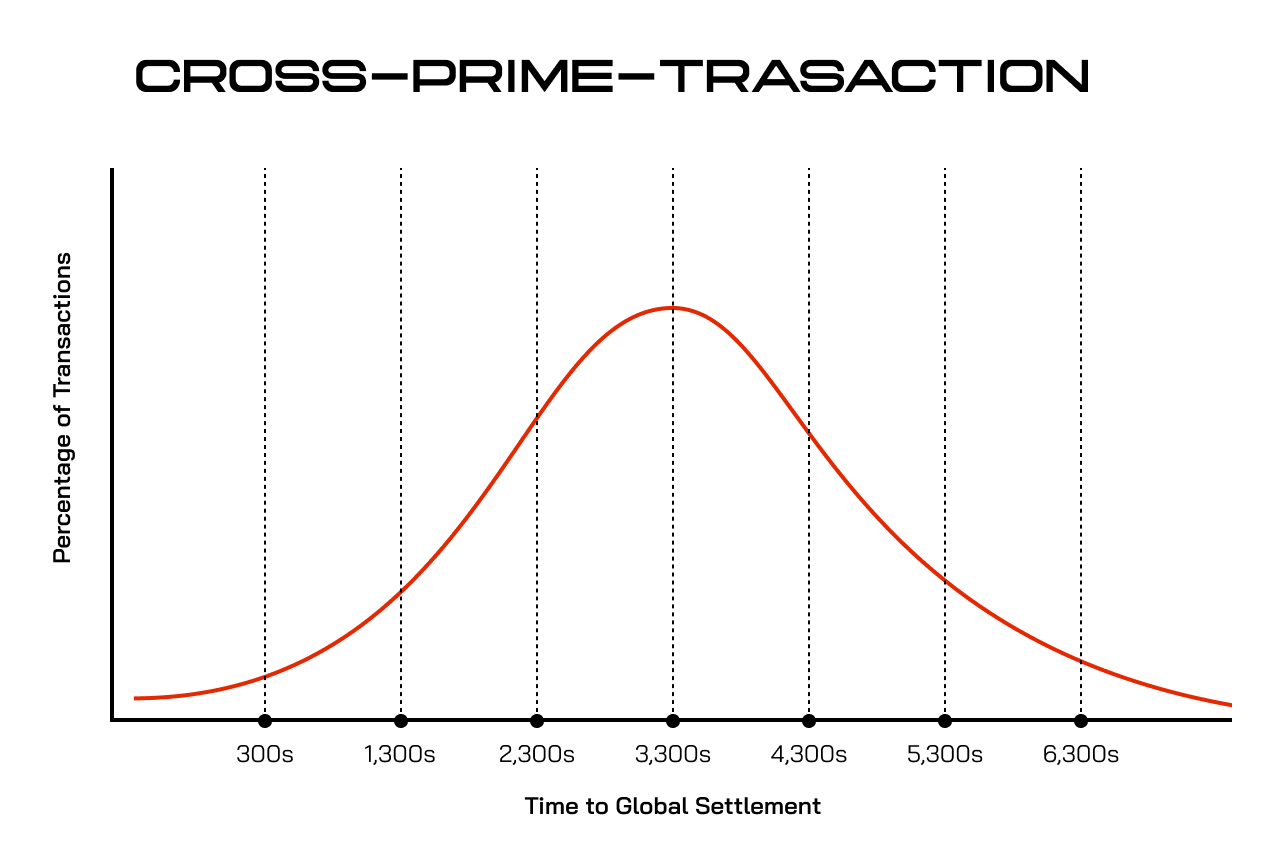
2. **3,300 seconds**: Global settlement (can spend funds in other regions)
**Why This Design Works:**
Most transactions happen within the same region where settlement is fast. Cross-chain operations are less frequent and users can plan accordingly.
## Settlement Time Calculation
**The Formula:**
Average time to Global (prime) settlement can be measured by the following equation, where:
* **TSₚ** = Average time to Global (prime) settlement (in seconds)
* **nz** = Number of zones per region
* **nr** = Number of regions in the system
* **tz** = Zone block time (in seconds) = 5
$$
TS_{p} = n_{z}^2 * n_{r}^2 * t_{z}
$$
**What This Means:**
* Settlement time increases with the square of both regions and zones per region
* **5 seconds**: Zone block time (where most transactions occur)
* **Total time**: Scales predictably with network size
## How the Network Knows When to Expand
The protocol monitors two key congestion indicators to determine when new capacity is needed:
### 1. Uncle Block Rate
**What are Uncle Blocks?**
Think of uncle blocks as "traffic jams" in mining. When multiple miners find valid blocks simultaneously, only one becomes part of the main chain - the others become "uncles."
**Why This Matters:**
* **High uncle rate** = Network congestion (too many miners competing for limited space)
* **Reduced efficiency** = Wasted mining energy and slower transaction finality
* **Clear signal** = Time to add more capacity
**How Quai Responds:**
When uncle blocks consistently exceed a threshold ratio, the protocol automatically:
1. Creates new region and zone chains
2. Integrates them into the global consensus
3. Distributes mining power across more chains
4. Reduces congestion and restores efficiency
**Result**: High hash efficiency maintained, fast finality preserved
### 2. Gas Limit Utilization
**What is Gas Limit?**
Each block has a maximum computational capacity (gas limit). When blocks consistently hit this limit, it means demand exceeds supply.
**The Fee Problem in Other Networks:**
* **Ethereum example**: When blocks are full, fees can reach \$50+ per transaction
* **Bidding wars**: Users compete by paying higher fees for limited block space
* **User experience**: Transactions become expensive and unpredictable
**Quai's Solution:**
When blocks consistently reach their gas limit, the protocol automatically adds new execution shards, ensuring:
* **Fees stay under \$0.01**: Increased capacity eliminates fee competition
* **No bidding wars**: Always enough block space to meet demand
* **Predictable costs**: Users know transaction fees will remain affordable
**Result**: Unlimited scalability without compromising affordability
## The Only Tradeoff: Settlement Time
**How Network Expansion Works:**
* **3×3 start**: 3 regions, 3 zones each = 9 total zones
* **First expansion**: 4×4 layout = 16 total zones
* **Growth pattern**: 5×5, 6×6, 7×7... unlimited expansion
**What's the Tradeoff?**
The only cost of adding capacity is increased **time to global settlement** - but this doesn't affect transaction safety or usability.
## Settlement vs Finality: Why This Matters
**Critical Distinction:**
* **Finality**: When your transaction is permanent and safe (seconds in Quai)
* **Settlement**: When funds can be spent cross-chain (minutes to hours)
**Real-World Impact:**
* ✅ **Your transaction is safe** immediately after finality
* ✅ **Recipients can trust payment** without waiting for settlement
* ⏳ **Cross-chain spending** requires settlement completion
**Example Timeline:**
1. **10 seconds**: Transaction finalized (safe and permanent)
2. **3,300 seconds**: Global settlement (can spend funds in other regions)
**Why This Design Works:**
Most transactions happen within the same region where settlement is fast. Cross-chain operations are less frequent and users can plan accordingly.
## Settlement Time Calculation
**The Formula:**
Average time to Global (prime) settlement can be measured by the following equation, where:
* **TSₚ** = Average time to Global (prime) settlement (in seconds)
* **nz** = Number of zones per region
* **nr** = Number of regions in the system
* **tz** = Zone block time (in seconds) = 5
$$
TS_{p} = n_{z}^2 * n_{r}^2 * t_{z}
$$
**What This Means:**
* Settlement time increases with the square of both regions and zones per region
* **5 seconds**: Zone block time (where most transactions occur)
* **Total time**: Scales predictably with network size
| Number of Regions | Number of Zones per Region | Total Zones | Time to Global Settlement† |
| ----------------- | -------------------------- | ----------- | -------------------------- |
| 3 | 3 | 9 | 405s |
| 4 | 4 | 16 | 1,280s |
| 5 | 5 | 25 | 3,125s |
| 6 | 6 | 36 | 6,480s |
| 7 | 7 | 49 | 12,005s |
| 8 | 8 | 64 | 20,480s |
**Important Notes:**
* Settlement times are **averages** - actual times vary due to the random nature of mining
* **\~50% of transactions** settle faster than the average time
* **All transactions** are final and secure well before settlement completes
**Understanding the Distribution:**
The diagram below shows how cross-chain transaction times are distributed. While the average global settlement is 3,300 seconds, half of transactions complete faster than this.