> ## Documentation Index
> Fetch the complete documentation index at: https://docs.qu.ai/llms.txt
> Use this file to discover all available pages before exploring further.
# Intrinsic Block Weight
> How blocks are measured and compared in Quai Network.
## The Problem with "Good Enough"
Traditional Proof-of-Work asks a simple question: "Does this block meet the minimum difficulty requirement?" If yes, the block is considered valid. If no, it's rejected.
**The Issue**: This ignores the actual work done. Imagine two students taking a test:
* Student A scores 85%
* Student B scores 95%
* Both pass the 80% requirement, but Student B clearly did more work
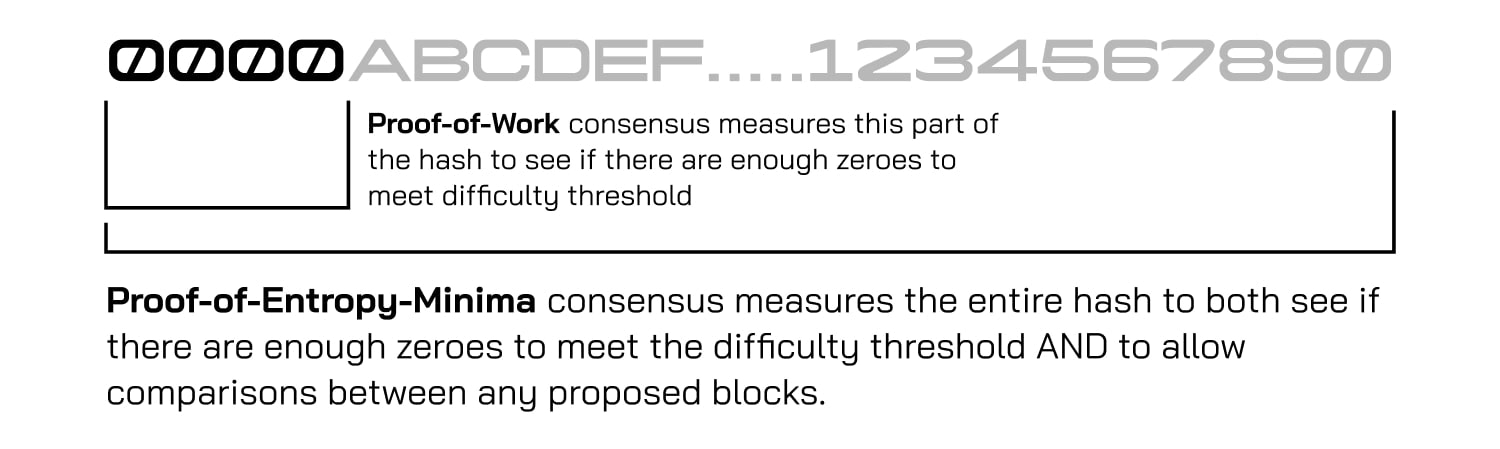
Traditional PoW treats both blocks as "equally valid" once they pass the threshold. PoEM recognizes that one block always represents more work than another.
## What is Intrinsic Block Weight?
**Intrinsic block weight** is like a "work certificate" - it measures exactly how much computational work went into creating a specific block.
Think of it as the difference between:
* **Pass/Fail grading** (traditional PoW): "Did you meet the minimum?"
* **Precise scoring** (PoEM): "Exactly how well did you do?"
This precision allows PoEM to make instant, objective decisions about which block represents the most work and should be accepted by the network.
## How It Works in Practice
When miners create blocks, they're essentially solving a mathematical puzzle. The "answer" they find (the block hash) tells us exactly how much work they did:
**Traditional PoW Logic:**
* Block hash starts with 16 zeros? ✅ Valid
* Block hash starts with 15 zeros? ❌ Invalid
* All valid blocks treated identically
**PoEM Logic:**
* Block A hash: `0x0000b9c86d37...` → 16.462525964 bits of work
* Block B hash: `0x0000b9c86d30...` → 16.462525967 bits of work
* Block B represents more work → Block B wins
This measurement gives PoEM several advantages:
**Instant Decisions:**
* No waiting to see which chain gets longer
* Every node makes the same choice immediately
* No mining power wasted on competing chains
**Perfect Fairness:**
* Most work always wins
* No randomness in fork resolution
* Miners are rewarded proportionally to work done
**Scalability:**
* Can coordinate unlimited parallel chains
* Each chain uses same objective measurement
* No coordination overhead between chains
 ## The Math Behind the Measurement
For those interested in the technical details, here's how intrinsic block weight is calculated:
**Simple Explanation:**
The more leading zeros a hash has, the more work it represents. PoEM measures this precisely using logarithms to get an exact "work score."
**The Formula:**
```
Work Done = Total Hash Length - log₂(Block Hash Value)
```
**Real Example:**
* Hash: `0x0000b9c86d37...`
* This gives us: 256 - log₂(0x0000b9c86d37...) = 16.462525964 bits of work
**Why This Works:**
* Finding a hash with more leading zeros requires exponentially more attempts
* The logarithm converts this exponential relationship into a linear measurement
* This gives us a precise "difficulty score" for each block
The exact mathematical calculation ensures that even tiny differences in work can be measured and compared objectively across the entire network.
## The Math Behind the Measurement
For those interested in the technical details, here's how intrinsic block weight is calculated:
**Simple Explanation:**
The more leading zeros a hash has, the more work it represents. PoEM measures this precisely using logarithms to get an exact "work score."
**The Formula:**
```
Work Done = Total Hash Length - log₂(Block Hash Value)
```
**Real Example:**
* Hash: `0x0000b9c86d37...`
* This gives us: 256 - log₂(0x0000b9c86d37...) = 16.462525964 bits of work
**Why This Works:**
* Finding a hash with more leading zeros requires exponentially more attempts
* The logarithm converts this exponential relationship into a linear measurement
* This gives us a precise "difficulty score" for each block
The exact mathematical calculation ensures that even tiny differences in work can be measured and compared objectively across the entire network.