> ## Documentation Index
> Fetch the complete documentation index at: https://docs.qu.ai/llms.txt
> Use this file to discover all available pages before exploring further.
# Calculating Total Entropy
> How total entropy accumulates in Quai Network.
## From Single Blocks to Entire Chains
We've seen how PoEM measures the exact work in a [single block](/learn/advanced-introduction/poem/fork-choice/intrinsic-block-weight). But how do we compare entire blockchains? This is where **total entropy** comes in.
Think of it like this:
* **Single block**: "How hard was this math problem?"
* **Entire blockchain**: "How hard was this entire series of math problems?"
## Why Entropy Instead of "Work"?
**Entropy** is a physics concept that measures randomness or disorder. When miners find a block, they're essentially **reducing randomness** by finding a very specific, ordered hash.
**The Key Insight**: The amount of randomness removed (entropy reduced) directly corresponds to the energy spent creating that order.
**Real-world analogy**:
* Messy room (high entropy) → Clean room (low entropy)
* Energy required to organize = Entropy reduced
* More organized = More energy spent = Lower entropy
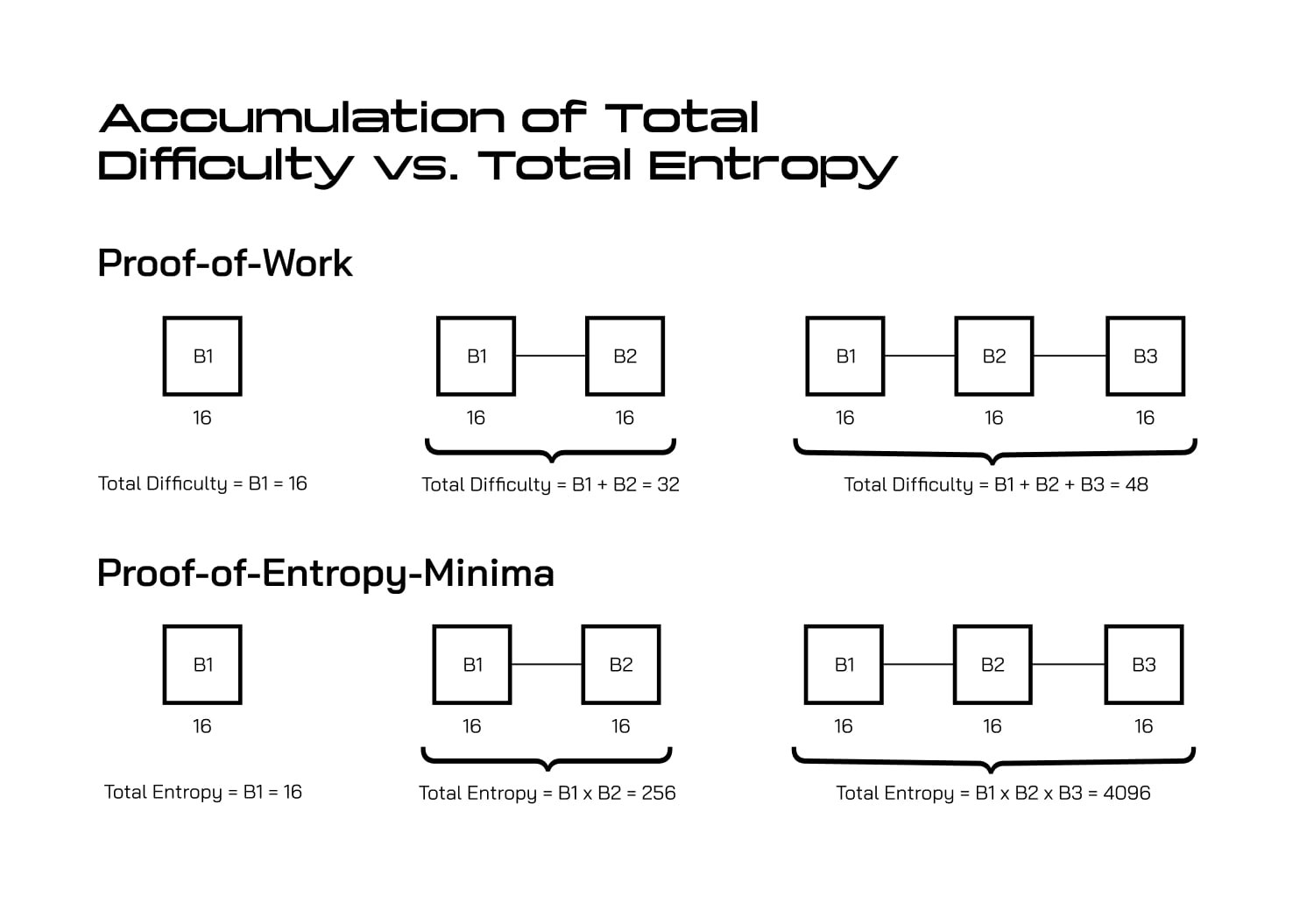
## Geometric vs Linear: Why It Matters
**Traditional PoW (Linear Addition):**
* Block 1: 16 difficulty points
* Block 2: 16 difficulty points
* Block 3: 16 difficulty points
* **Total**: 16 + 16 + 16 = 48 points
**PoEM (Geometric Multiplication):**
* Block 1: Removes 1/65536 of possible states
* Block 2: Removes 1/65536 of remaining states
* Block 3: Removes 1/65536 of remaining states
* **Total**: (1/65536) × (1/65536) × (1/65536) = Much more security
**Why Multiplication is Better:**
* **Exponential security**: Each block makes the chain exponentially harder to recreate
* **Real probability**: Reflects the actual odds of recreating the work
* **Better comparison**: More accurately measures which chain required more total energy
Think of it like compound interest: adding 10% three times gives you 130%, but compounding 10% three times gives you 133.1%. The difference becomes massive over many blocks.
 ## Step-by-Step Calculation
### Step 1: Calculate Single Block Entropy
For each block, we calculate how much randomness it removed:
**Simple Version**: More leading zeros = more randomness removed
**Precise Formula**:
```
Block Entropy = 1 / (2^leading_zeros)
```
**Example**:
* Block with 16 leading zeros: 1/65,536 states removed
* Block with 17 leading zeros: 1/131,072 states removed (twice as rare!)
### Step 2: Calculate Chain Total
For an entire blockchain, we multiply all the individual block entropies together:
**Formula**:
```
Total Chain Entropy = Block1 × Block2 × Block3 × ...
```
**Example 3-Block Chain**:
* Block 1: 1/65,536
* Block 2: 1/65,536
* Block 3: 1/131,072
* **Total**: (1/65,536) × (1/65,536) × (1/131,072) = 1 in 563 trillion
This means recreating this 3-block chain would require, on average, 563 trillion attempts!
## Practical Implementation: Using Logarithms
**The Problem**: Those numbers get huge fast! After just 10 blocks, we'd be dealing with numbers so large they're impossible to store efficiently.
**The Solution**: Instead of storing the actual multiplication results, we use logarithms to convert multiplication into addition.
**How It Works**:
* **Traditional storage**: 1/65,536 × 1/65,536 × 1/131,072 = 0.000000000000234
* **Logarithmic storage**: 16 + 16 + 17 = 49 bits of entropy
**Benefits**:
* **Manageable numbers**: Addition instead of astronomical multiplication
* **Exact precision**: No loss of accuracy in comparisons
* **Efficient storage**: Quai uses 64 bits to store total entropy per chain
* **Easy comparison**: Higher entropy number = more secure chain
**The Final Formula**:
```
Total Chain Entropy (in bits) = Block1_bits + Block2_bits + Block3_bits + ...
```
This mathematical trick allows Quai to precisely compare chains of any length while keeping the computation practical for real-world use.
**Key Takeaway**: PoEM measures the exact probability of recreating any blockchain, giving it perfect objectivity when choosing between competing chains. The chain that would be hardest to recreate always wins.
## Step-by-Step Calculation
### Step 1: Calculate Single Block Entropy
For each block, we calculate how much randomness it removed:
**Simple Version**: More leading zeros = more randomness removed
**Precise Formula**:
```
Block Entropy = 1 / (2^leading_zeros)
```
**Example**:
* Block with 16 leading zeros: 1/65,536 states removed
* Block with 17 leading zeros: 1/131,072 states removed (twice as rare!)
### Step 2: Calculate Chain Total
For an entire blockchain, we multiply all the individual block entropies together:
**Formula**:
```
Total Chain Entropy = Block1 × Block2 × Block3 × ...
```
**Example 3-Block Chain**:
* Block 1: 1/65,536
* Block 2: 1/65,536
* Block 3: 1/131,072
* **Total**: (1/65,536) × (1/65,536) × (1/131,072) = 1 in 563 trillion
This means recreating this 3-block chain would require, on average, 563 trillion attempts!
## Practical Implementation: Using Logarithms
**The Problem**: Those numbers get huge fast! After just 10 blocks, we'd be dealing with numbers so large they're impossible to store efficiently.
**The Solution**: Instead of storing the actual multiplication results, we use logarithms to convert multiplication into addition.
**How It Works**:
* **Traditional storage**: 1/65,536 × 1/65,536 × 1/131,072 = 0.000000000000234
* **Logarithmic storage**: 16 + 16 + 17 = 49 bits of entropy
**Benefits**:
* **Manageable numbers**: Addition instead of astronomical multiplication
* **Exact precision**: No loss of accuracy in comparisons
* **Efficient storage**: Quai uses 64 bits to store total entropy per chain
* **Easy comparison**: Higher entropy number = more secure chain
**The Final Formula**:
```
Total Chain Entropy (in bits) = Block1_bits + Block2_bits + Block3_bits + ...
```
This mathematical trick allows Quai to precisely compare chains of any length while keeping the computation practical for real-world use.
**Key Takeaway**: PoEM measures the exact probability of recreating any blockchain, giving it perfect objectivity when choosing between competing chains. The chain that would be hardest to recreate always wins.